How to Write a Short Story: Outlining and Form
Let me start off by saying that some authors love writing short stories, while others prefer novels. However, if you can nail down how to write a short story, the skillset will only enhance your novel writing.
Creating short stories isn’t that different from writing a novel—hear me out—the key differences between the mediums are brevity (a.k.a a smaller word count), and succinct storytelling. I’ll clear this idea up within the article where you’ll learn what a short story is, how to outline them, and various writing forms to enrich your craft. Okay—grab a cup of coffee, a notebook, and dive in!

If you’ve ever researched how to write a novel, then you’ve likely come across this advice: write short stories before writing a novel. There’s a reason you hear that statement everywhere on the internet and from your creative peers. This is because when you learn how to write a cohesive and clear short piece of fiction, that only makes your novel writing more concise and powerful. Like anything in life, practice makes perfect. And writing short stories is a terrific method for perfecting your craft.
Disclaimer: This post may include affiliate links. If you purchase through our link, we will receive a small commission at no additional cost to you. See our full disclosure policy, here.
What is a short story?
A short story by definition is literally within the title itself— a short story. This medium tends to be about 1,000-10,000 words per piece. However, these are guidelines— your writing is truly up to you as the writer, and we will dive more into form within this blog post.
Short story examples:
Ernest Hemingway and F. Scott Fitzgerald are two writers from the Jazz Age who honed their craft by writing a plethora of short stories. There’s a reason their works are revered today. They wrote constantly. They were amazing storytellers because they perfected their craft. If you’re wondering where to start when it comes to reading short stories, I highly recommend those two authors.
Bernice Bobs Her Hair by F. Scott Fitzgerald. Read my analysis on his short story. This piece is slightly over 10,000-words and shows us how to write a character going on an emotional journey of change through one thematic statement.
Another great example that I’ve written a story analysis on is, Up in Michigan by Ernest Hemingway. This short story is just over 1,000 words. It also takes us on an emotional journey through one main character and one theme.
Both of these stories use a mini-arc. The theme they’ve chosen to explore is expressed through a beginning, middle, and end alongside a character. We’ll talk more about what a mini-arc is and how to utilize them further into the article. (You’ll also get a free guide and story example.)
How are novels and short stories similar? How are they different?
Differences between a short story and a novel
Let me circle back to my initial statement at the beginning of this article. The differences between novel writing and short stories are the latter’s brevity and succinct storytelling. What do I mean? To begin, short stories simply have less words. Unlike a novel, they don’t include multiple subplots or complex worldbuilding systems, if any at all. And finally, they tend to focus on a smaller cast of characters.
The main objective of short stories is to tell a brief tale of one thematic message. This can be done through a character who goes on a transformative journey, or it’s expressed thorough a few scenes.
While these may seem like rules, think of them more as guidelines to short story writing. Art is ultimately up to its creator. Rules can be broken, molded, and transformed to fit your narrative. This leads me to the next point about writing form and voice.


Short Story Writing Forms
First, let’s discuss voice. The more you write short prose, the more writing practice you’re getting, and the sooner you will find your author voice. There is no writing advice article, or YouTube video that will help you find your voice. This is entirely unique to each individual. You must practice the craft. Start writing.
Now, let’s dive into utilizing various writing forms within short fiction.
What’s exciting about writing short prose is that they don’t (typically) take as long to write. You can experiment with different writing forms for each piece you design.
These forms may include a short story, flash fiction, micro-fiction, vignettes, or even poetry. Depending on you as the author and the narrative you’re writing, short prose will typically encompass a mini-arc, which may include: one scene, a few scenes, or a character’s internal reflection on the theme.
Unlike a novel, which is often written with a strict structure such as the three-act structure, the hero’s journey, etc. (although those rules can also be bent), short stories tend to be a unique expression of the author’s theme.
Here’s a perfect example of a short form of fiction that is categorized as a vignette. The piece consists of about 75 words. I’m referring to the piece that’s widely known as Chapter 8, from In Our Time by Ernest Hemingway.
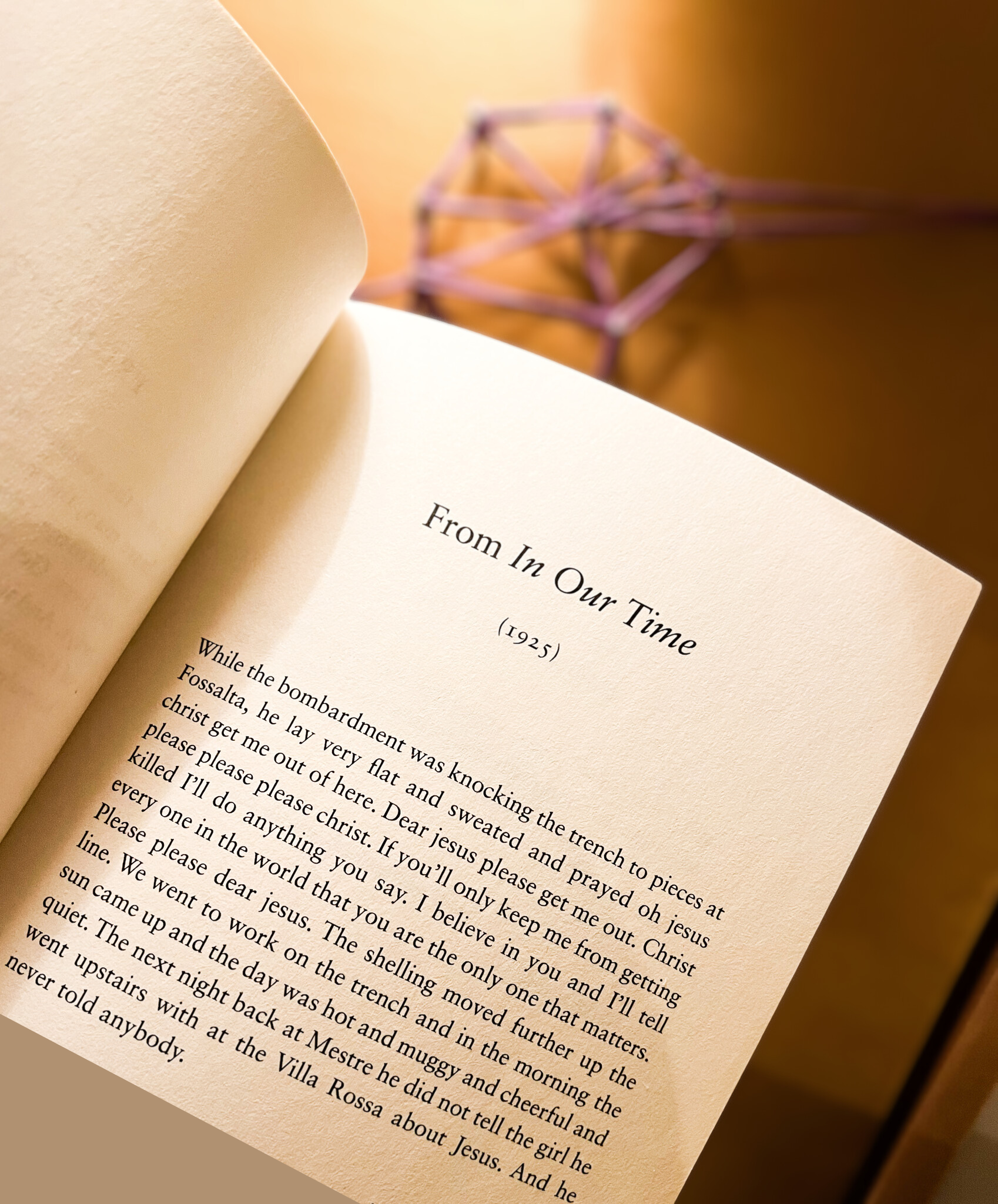
Ernest Hemingway, The Hemingway Stories, Scribner, March 2 2021
You can find this piece in a collection of short stories.
Ernest Hemingway has another great example of a short story within the same collection. (His prose is truly a masterclass on storytelling.) Hills Like White Elephants.
This story is about two people coming to terms with the consequences of their affair. Ernest Hemingway wrote Hills Like White Elephants in just under 1,500 words.
This short story introduces us to the characters, the setting, conflict, and by the end of it, there is a resolution. We don’t receive a character transformation per-se, instead this story has a mini-arc solving the conflict presented in the set-up.
Hemingway still wrote these characters with emotional depth and duality. But it’s how they react to the conflict within their conversation and the emotional subtext that makes this piece so powerful. The characters don’t directly say what they mean, nor do they confront the truth, but there’s a resolution to their conversation. This story teaches writers how to write subtext among other literary devices within the piece.
If you want to learn more, check out this blog post. It explores the depths of this short story in detail.
Similarities between short stories and novels
Short stories and novels have a similar foundation; they follow a theme through a character. These stories encompass a beginning, middle, and end. They explore a theme through a character on a journey of change. However, within short prose, these elements are brief and succinct.
What are the storytelling elements of short stories?
Elements of short story fiction:
Theme
Main character
Setting
Conflict
Plot
I know what you’re thinking: how is that different from a novel? Keep reading. The most important aspects of short prose are your theme, main character, and the conflict.
Naturally your story will have a setting—that goes without saying. And the plot will be a brief sequence of the unfolding events that get your character from point A to point B, which will focus on one main conflict. If you’re uncertain on how to write conflict, this storyteller is a genius, and I highly recommend watching her video. However, what makes a short story unique from a novel is within the narrowed focus of the theme, character, and conflict.
If you are a writer who wants a structure to build a short story, I recommend using a mini-arc. Based on research of the craft, reading various short stories, and writing my own prose, this mini-arc diagram below sums up my findings.
A mini-arc consists of a set-up, conflict, and resolution. These elements must weave through your theme. Now, when I say a resolution, your character doesn’t need to have a transformation arc, unless that’s the kind of story you’re telling. Nor does the resolution have to be positive, it can be a negative resolution, depending on how and where you’re using the mini-arc within the story. However, you must always resolve the conflict you introduced in the set-up. Here’s an example of what a mini-arc looks like.

You can use this mini-arc guide to outline your entire short story, or to outline scenes in your novel.
Short Story example using the mini-arc guide from my short story:
A Stable Home
The full short story is linked below if you’re interested in reading it.
*This example includes spoilers.*
The Set-Up: Two brothers are disheartened with their lives; they live with a tyrannical and absent mother. One night, she goes too far, and the boys pray in desperation to get the loving mother they once had back.
Rising Action of Conflict: A magical star comes to earth and speaks to them about how to get their mother back. So, they do it, only to discover she can’t talk anymore.
Climax: The eldest is plagued by what they’ve done but doesn’t know how to reverse their wish. He wants to do all he can to figure out how to fix it, and along the way, the three of them remember who they were before their lives dimmed. Since the kids are desperate to get a speaking mother, they pray again. But a storm is brewing and the youngest falls, nearing death.
Consequences or Reflections: Their mother reflects on her actions because her youngest is near-death and she didn’t notice the signs that were there all along. His near-death awakens her.
Resolution: She saves her child, they are healed, she can speak, and she let’s go of her own pain to become the mother she was meant to be. They are a family again.
Read the short story for free! ↓
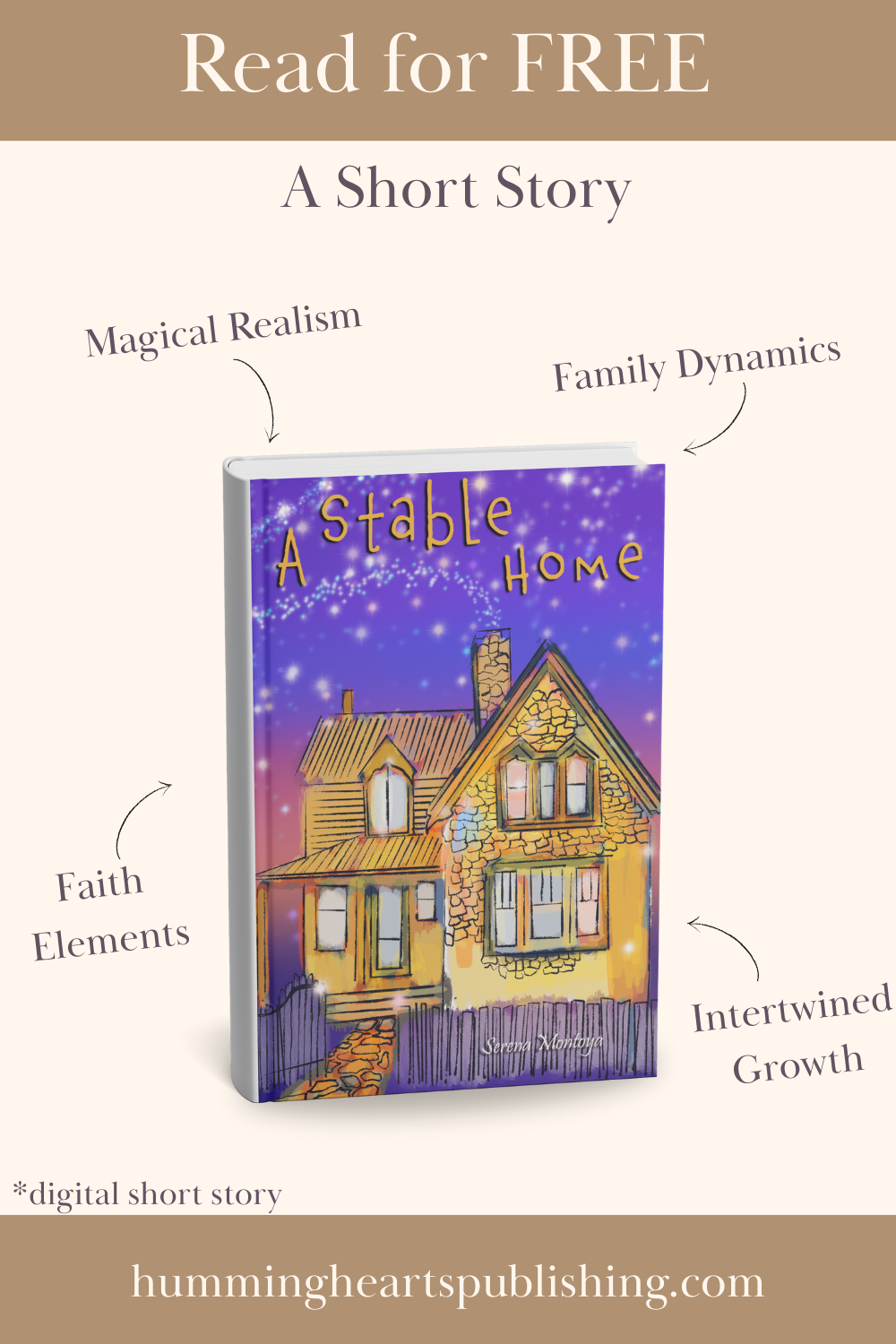
by Serena Montoya
Blurb: When two brothers, longing for the love of their distant mother, call upon a star in desperation, their wish is answered in an unexpected way. Now, Milo and Ezra are plagued with guilt and uncertainty as their mother deals with a malady of their making. Will she overcome her demons and be the parent she once was, or will a broken past upend any hope these boys have for a stable home?
How to outline a short story
Truthfully, I didn’t initially outline when I wrote my first two short stories (including the one above). Not doing so was a HUGE mistake because I ended up writing several drafts. Save yourself the time and many unnecessary headaches—outline your story!
This short story patterns a character arc or transformation, much like a novel, which is why not outlining wasn’t the right choice. This short story is just over 5,000 words. Writing short stories has taught me how to tell a story.
I recently wrote a fiction vignette in a writing exercise, which you can read here. I didn’t outline this piece, but I definitely jotted down some ideas before diving right in.
The next short story I’m writing is currently going through the outlining process.
My Short Story Outlining Process
What I’m referring to in this section are short stories that follow the mini-arc guide above.
When I’m outlining a short story, I focus on five aspects:
The brain dump - whether I’m writing a short story, novella, or a novel, the brain dump is crucial. I get out all of my impressions and ideas here. It doesn’t have to be cohesive, just write it all down.
Theme - the key to any great story lives in your theme. What is the message you want to share?
Characters - Who is this story about and why is it specific to them? You’ll need to know your theme before you uncover this about your characters.
Conflict - What are the obstacles that will get in your character’s way for their growth? What internal and external conflict does the character face that explores the theme of your story?
Plot - Plot out the sequence of events that will give your character momentum within the narrative. Use the mini-arc guide. Show yourself how the story will unfold before drafting it, doing so will save you a ton of time in the editing room.
Again, I highly recommend outlining, otherwise you’re flying by the seat of your pants and will get lost during the writing stage. As I’ve mentioned before, outlining is crucial to the writing process. When you build a roadmap, you save a lot of time and many unnecessary headaches editing multiple drafts. Trust me. I’ve been there.
After you’ve nailed down these elements of your short story’s outline, you will feel more confident drafting.
Happy writing!